
Quick answer
- An advisory is a warning, not a fail. Your car still passes.
- No law makes you fix it by a set date, but the car must be roadworthy every time you drive it.
- Sort out tyres, brakes, steering and suspension first.
- The same advisory two years running usually means nobody fixed it.
What is an MOT advisory?
When a tester checks your car, they sometimes find a part that's fine today but won't stay that way for long. It might be a tyre getting close to the legal limit, a brake pipe with some surface rust or a small oil leak.
The part still meets the standard, so the car passes. The tester writes it down as an advisory to give you a heads up that it will need attention soon.
Advisories appear at the bottom of your MOT result, and they stay on the car's record for good. Anyone can see them with our MOT history check, so a buyer will spot them if you sell the car later.
Advisory, minor, major or dangerous?
Since May 2018, testers put every problem into one of four groups. Only two of them cause a fail.
| Result | What it means | Pass or fail? | Can you drive it? |
|---|---|---|---|
| Advisory | Something to watch. It isn't a fault yet | Pass | Yes |
| Minor | A small fault with little effect on safety right now | Pass | Yes, but fix it soon |
| Major | Could affect safety or harm the environment | Fail | Only if your old MOT is still valid. Get it repaired straight away |
| Dangerous | A direct risk to road safety | Fail | No, not until it's repaired |
The gap between an advisory and a minor is small. A minor is already a fault. An advisory tells you a fault is on its way.
How to read the tester's wording
Testers use a set of standard phrases, so MOT advisory notes can look like code at first. Here's a real example:
Nearside front brake pipe corroded, not seriously weakened (1.1.11 (c))
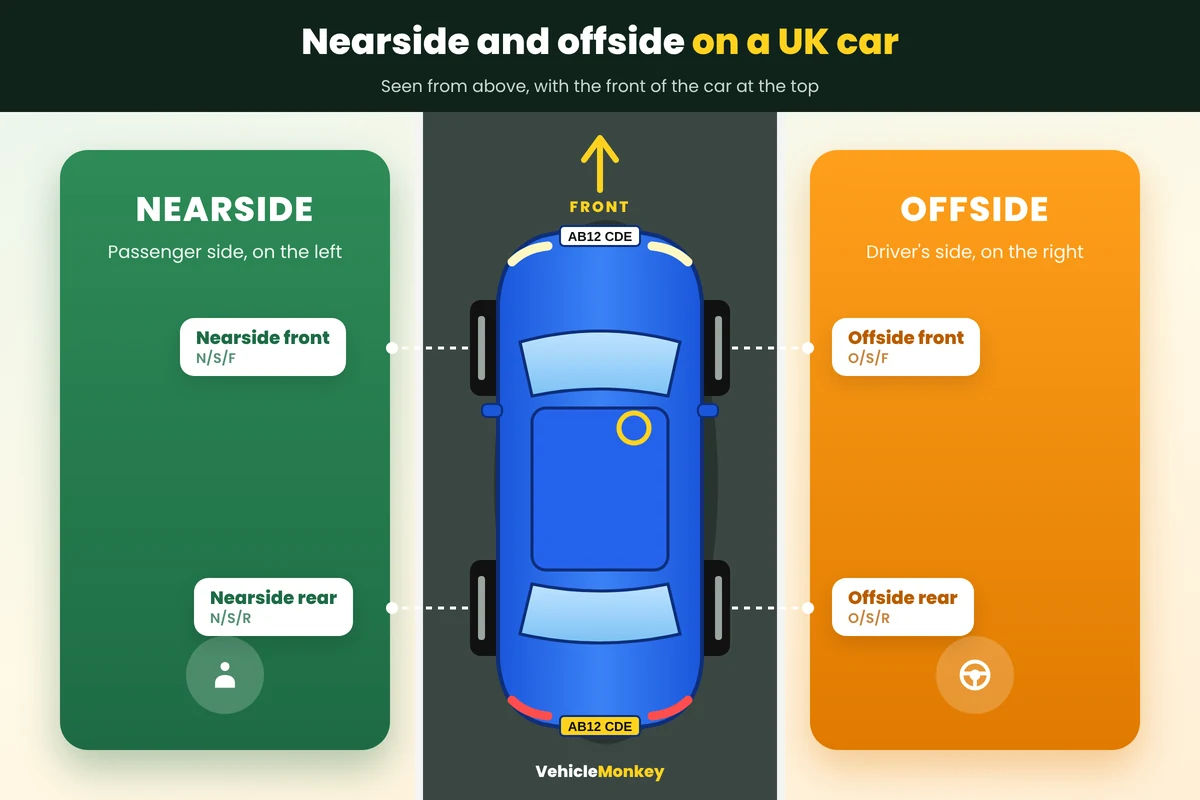
- Nearside means the passenger side of a UK car, which is the left. Offside is the driver's side, on the right.
- "Not seriously weakened" tells you the tester checked how bad it is, and it's still safe.
- The number in brackets points to the part of the DVSA's MOT inspection manual the tester used. The first digit tells you which area of the car it's about.
| First number | Area of the car |
|---|---|
| 1 | Brakes |
| 2 | Steering |
| 3 | Visibility, such as the windscreen, wipers and mirrors |
| 4 | Lights and electrics |
| 5 | Axles, wheels, tyres and suspension |
| 6 | Body and structure, including rust |
| 7 | Other equipment, such as seat belts and airbags |
| 8 | Emissions, fluid leaks and noise |
Common MOT advisory wording and how soon to act
Not every advisory is urgent. Work through them in this order: tyres, brakes, steering and suspension, rust, then everything else. The table shows the notes you're most likely to see and our advice on timing.
| Typical wording | What it means | How soon to act |
|---|---|---|
| Tyre worn close to the legal limit | The tread is nearly down to 1.6mm | Within weeks. Grip in the wet is already lower |
| Brake pad(s) wearing thin | The pads are near the end of their life | Within a month or two, before they damage the discs |
| Brake disc worn, pitted or scored, but not seriously weakened | The discs are wearing but still safe | Plan it, usually with the next set of pads |
| Brake pipe corroded, not seriously weakened | Rust on a metal brake pipe | Within a few months. Garages replace a rusty pipe rather than patch it |
| Track rod end ball joint has slight play | A little wear in the steering | Soon. Steering wear tends to get worse quickly |
| Suspension arm pin or bush worn | The rubber mounts are wearing | Within a few months, sooner if the tyres wear unevenly |
| Corroded, but not seriously weakened | Rust starting on the body or subframe | Get it treated before the next winter |
| Oil leak, but not excessive | A small leak | Check the oil level often and fix it when it suits you |
Tyres top the list for a reason. The legal limit is 1.6mm of tread across the middle three quarters of the tyre, all the way round, but grip in the wet drops well before that. Plenty of drivers swap tyres at about 3mm.
Steering wear is the one people underestimate. In Torqueflow's analysis of DVSA records, a track rod end advisory turned into a fail at the next test more often than any other common advisory, at 16.2%.
Do you have to fix MOT advisories?
No law makes you fix an advisory by a set date. The law does say your car must be roadworthy every time you drive it, though, not just on test day. If an advised part wears past the limit, the car stops being legal to drive, even with a valid MOT.
Tyres are the best example. The police can fine you up to £2,500 and give you 3 penalty points for each illegal tyre, and that applies the day after your MOT as much as the day before.
Insurance is the other risk. If you have a crash and the insurer finds that a fault the tester warned you about played a part, it could pay out less or refuse the claim. An advisory on your record shows you knew about it.
So you don't have to fix it today. You do need to watch it and get it sorted before it turns into a real fault.
How many advisories is normal?
A car that's only three or four years old often passes with none at all. Older cars usually pick up a few, because tyres, brakes and rubber parts wear with every mile.
The number still tells you something, though. Torqueflow's figures show the chance of failing the next MOT climbs with each advisory:
| Advisories at this MOT | Failed the next MOT |
|---|---|
| None | 20.0% |
| One | 28.4% |
| Three | 34.3% |
| Six or more | 42.0% |
So a long list isn't a reason to panic, but it is a good reason to book the car in before the next test, not after it.
Buying a car with MOT advisories
A few advisories on a used car aren't a reason to walk away. Almost every car over five years old has some. What matters is what they are and whether anyone dealt with them.
- The same note year after year means the owner left it. Ask for a receipt, or take the repair cost off your offer.
- Wording that gets worse each year, such as surface rust turning into corrosion, shows a problem that's growing.
- Notes from the last test only are worth asking about, as the seller may have sorted them since. A receipt is the only proof.
Run the reg through our MOT history check before you go to see the car, and you'll know exactly what to ask about. If the current MOT is close to running out, check when the MOT is due and ask the seller to put the car through a fresh test before you buy.
Frequently asked questions
Can I drive my car with an advisory?
Yes. An advisory means the car passed, so you can drive it as normal. Keep an eye on the part, though, because the car has to be roadworthy every time you use it, not just on test day.
Do advisories affect my insurance?
Not directly. Insurers don't usually ask about them when you buy cover. But if a fault the tester warned you about causes a crash or makes it worse, the insurer could pay less or refuse the claim.
Can my car fail next year on the same advisory?
Yes, if the part has worn past the limit by then. A tyre that is close to the limit this year will often be below it by the next test.
Should I fix advisories before I sell my car?
Fix the cheap ones, like tyres or wiper blades, because buyers can see every advisory online. For bigger jobs, get a quote and take it off the asking price instead.
Why did my car get advisories it didn't have last year?
Parts wear out, and a different tester may spot different things. New advisories are normal on an older car. The ones that come back year after year matter more.