Quick answer
- Check the MOT record, mileage and MOT date online before you travel.
- View the car at the address on the logbook, in daylight, with the engine cold.
- Make sure the VIN on the car matches the V5C.
- Walk away if the seller rushes you, has no logbook or wants a deposit first.
Before you go to see the car
Half of what to check when buying a used car happens before you leave home. Ask the seller for the registration number, make, model and MOT test number, then run these checks:
- The MOT record. A car's MOT test history lists every fail and advisory since 2005. Watch for advisories that keep coming back and long gaps between tests.
- The mileage. Testers log the reading at every MOT, so the car's mileage records should only ever go up.
- The MOT date. A car with only a few weeks left could need a test, and maybe repairs, soon after you buy it. Check the expiry date so you know how long you have.
- The DVLA details. The make, model, colour and engine size on the DVLA's vehicle enquiry service should match the advert.
- Safety recalls. GOV.UK has a free vehicle recall checker. Garages fix recalls for free, but you want to know someone has done the work.
- Finance, write-offs and theft. These records are private, so you need a paid history check. Most cost around £10 to £20, which is nothing next to the price of the car.
Ask a few questions on the phone as well. How long have they owned it? Why are they selling? When did it last have a new cambelt? Honest sellers answer easily, and the answers often tell you more than the advert.
Check the logbook and paperwork
Arrange to see the car at the address printed on the V5C logbook, not in a car park or a lay-by. Then go through the paperwork before you look at anything else.
- The watermark. A genuine V5C has a "DVL" watermark when you hold it up to the light.
- The serial number. Thieves stole blank logbooks with serial numbers between BG8229501 and BG9999030, and between BI2305501 and BI2800000. If the number on yours falls in either range, GOV.UK says to leave and call the police.
- The VIN. Find the vehicle identification number on the car, usually at the bottom of the windscreen and on a door pillar, and make sure it matches the logbook.
- The seller's name. The person selling should be the keeper named on the V5C. If they aren't, ask why.
- Service history. Look for stamps or invoices at regular intervals, and a receipt for the cambelt if the car is due one.
Your used car checklist on the driveway
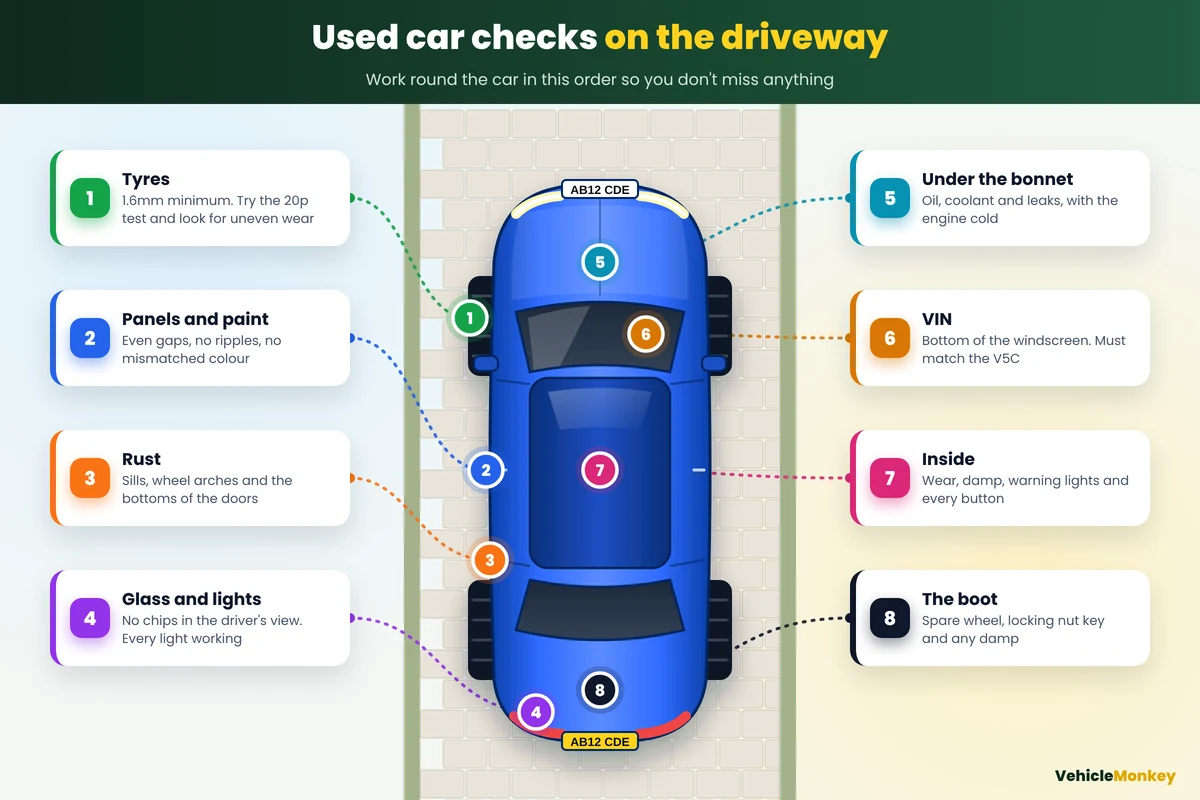
Do your used car checks in daylight and when it's dry, as rain hides scratches and dents. Ask the seller not to start the car before you arrive, because a cold engine shows problems a warm one can hide.
Outside
- Tyres. The legal limit is 1.6mm of tread. Push a 20p coin into the grooves. If you can see the outer band, the tyre is close to the limit. Uneven wear can point to tracking or suspension problems.
- Panels and paint. Look along each side for ripples, and check the gaps between panels are even. A slightly different shade on one door or wing means someone has repainted it.
- Rust. Check the sills, wheel arches and the bottoms of the doors. Bubbling paint is often rust starting underneath.
- Glass and lights. Chips in the driver's view can fail an MOT. Ask the seller to work every light while you walk round.
Inside
- Wear. The steering wheel, gear knob, pedals and driver's seat should match the mileage.
- Damp. A musty smell, wet carpets or a tide mark in the boot can mean a leak or flood damage.
- Warning lights. They should all light up when you turn the key, then go out once the engine starts.
- Electrics. Try the windows, central locking, heater, air conditioning and every button you can find.
- The extras. Check for the spare wheel or repair kit, the locking wheel nut key and both keys.
Under the bonnet
- Oil. Pull the dipstick. The level should sit between the marks, and the oil shouldn't look like thick black sludge.
- The oil filler cap. A creamy deposit that looks like mayonnaise can be a sign of head gasket trouble, although short trips in cold weather can cause it too.
- Coolant. It should be between the marks and look clean, not brown or oily.
- Leaks. Look under the engine and on the ground where the car usually sits.
The test drive
Of all the used car checks, this is the one you can't skip. Drive for at least 20 minutes if you can, on slow roads and faster ones. You need insurance to drive it, so sort this out before you set off.
- Starting up. Listen for rattles and watch the exhaust. Blue smoke means it's burning oil, and thick white smoke that doesn't clear can mean a coolant leak.
- The clutch. If it only bites right at the top of the pedal, it may be close to needing a new one.
- Gears. They should change smoothly, with no crunching or jumping out of gear.
- Brakes. The car should stop in a straight line, without pulling, grinding or a juddering pedal.
- Steering and suspension. The car should drive straight with your hands light on the wheel. Knocks over speed bumps point to worn suspension parts.
Red flags that mean walk away
A lower price can make up for some problems. Not these, so if you see any of them, thank the seller and leave:
- No V5C, or a story about it being "with the DVLA"
- The VIN on the car doesn't match the logbook
- The seller wants to meet somewhere other than the address on the V5C
- A request for a deposit before you've seen the car
- A price far below every similar car you've seen
- Mileage that dropped between MOTs with no paperwork to explain it
- The seller won't let a mechanic look at it
Most things to check before buying a used car take minutes. All of them together take about 15 minutes at home and an hour at the viewing, which is time well spent next to the cost of a bad car.
Dealer or private seller: your rights
| Dealer | Private seller | |
|---|---|---|
| The car must be as described | Yes | Yes |
| The car must be of satisfactory quality | Yes | No |
| 30 days to reject a faulty car | Yes | No |
| Usually cheaper | No | Yes |
Dealer rights come from the Consumer Rights Act 2015. A private sale is "sold as seen", so the checks you do on the driveway matter even more.
Paying and after you buy
- Pay when you collect. Bank transfer leaves a record. Only pay once you have the car, the keys and the logbook in front of you.
- Get a receipt. It should show both names, the price, the date, the reg and the mileage.
- Keep the new keeper slip. The seller gives you the green slip from the V5C and tells the DVLA about the sale. Your new logbook should arrive within a few weeks.
- Tax it straight away. Tax doesn't pass to the new owner, so you need to tax the car before you drive it home. You can do it online with the new keeper slip.
- Insure it before you drive. Set up your cover before you set off, not on the way home.
Frequently asked questions
What documents should I get when I buy a used car?
You should leave with the green new keeper slip from the V5C logbook, the service history, any old MOT certificates and a written receipt. Ask for both keys too, as a spare can cost a lot to replace.
Do I need insurance to test drive a used car?
Yes. Dealers usually have their own trade cover. With a private seller, you need your own cover, so check whether your policy lets you drive other cars or buy short term cover for the day.
Can I return a used car if something goes wrong?
If you bought it from a dealer, you have 30 days to reject it for a full refund if it was faulty when you bought it. A private sale gives you far less protection, unless the seller lied about the car.
Should I get a used car inspected before I buy it?
For anything over a few thousand pounds, it's worth it. A mechanic will spot problems you can't see on a driveway, and the report gives you something to haggle with.
Is it safe to buy a Cat S or Cat N car?
It can be, as long as someone repaired it properly. These cars should cost a lot less, so get one inspected and check your insurer will cover it before you buy.