Quick answer
- An MOT checks safety and emissions: lights, tyres, brakes, steering, seatbelts, windscreen, exhaust and more.
- It doesn't check the engine, clutch or gearbox.
- Most tests take 45 minutes to an hour and cost no more than £54.85 for a car.
- Bulbs, tyres and wipers cause lots of fails, and you can check all three at home in minutes.
Every MOT follows the same DVSA rulebook, whether you go to a main dealer or the small garage round the corner. That's good news for you. It means you can know exactly what the tester will look at, and sort out the easy things before you go.
What is checked in an MOT, part by part
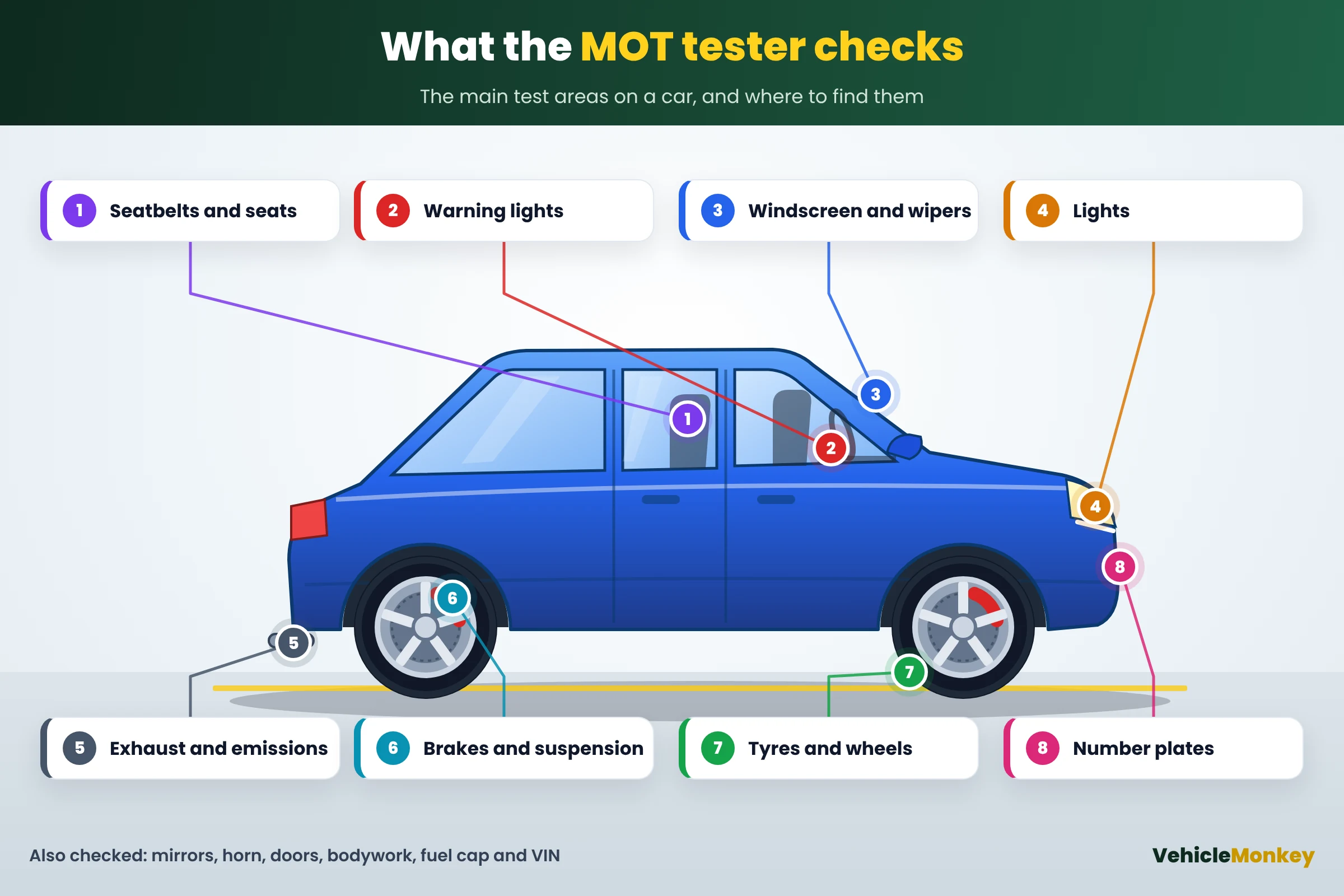
Here's what the tester checks on a car, with the problems that most often turn a pass into a fail. GOV.UK also publishes the official list of car parts checked if you want the full wording.
| Part | What the tester checks | What usually fails it |
|---|---|---|
| Lights | Every light works, shows the right colour and points the right way | A blown bulb, a cracked lens or headlights aimed too high |
| Tyres and wheels | Tread depth, cuts, bulges, the right size and type, and secure wheels | Tread under 1.6mm across the middle three quarters of the tyre |
| Brakes | How hard and how evenly each wheel brakes, plus pads, discs, pipes and the handbrake | Pads worn below 1.5mm, or the car pulling to one side |
| Steering and suspension | Wear in the joints, springs, shock absorbers and the steering lock | A broken coil spring or a worn ball joint |
| Windscreen and wipers | Chips and cracks in the driver's view, and wipers and washers that clear the glass | Damage over 10mm right in front of the driver, or over 40mm elsewhere in the wiper area |
| Seatbelts and seats | Every belt is there, locks and fastens, and the driver's seat adjusts and stays put | A frayed belt or a buckle that won't click shut |
| Exhaust and emissions | No serious leaks, the catalytic converter is fitted, and the gases or smoke stay within limits | Too much smoke, or a diesel particulate filter that someone removed |
| Warning lights | Dashboard lights come on with the key, then go out | An engine, ABS, airbag or brake light that stays on |
| Body and doors | Rust near key mounting points, sharp edges, and doors, bonnet and boot that open and shut properly | Heavy rust near the brakes or suspension, or a door that won't open from inside |
| Number plates and VIN | Plates are secure, readable and use the legal font and spacing, and the VIN is easy to find | Fancy fonts, squashed spacing or a faded plate |
| Mirrors, horn and fuel cap | Mirrors are there and secure, the horn works, and the fuel cap seals | A horn that doesn't sound, or a fuel cap that won't seal |
Since May 2018, testers grade each fault as minor, major or dangerous. A minor fault still passes. A major or dangerous one means a fail.
Your MOT checklist: 15 minutes at home
Plenty of first-time fails come down to things the owner could have spotted on the driveway. Pick an evening, grab a helper for the lights and work through this MOT checklist:
- Lights. Switch on each one in turn: sidelights, dipped beam, main beam, indicators, hazards, rear fog light and the number plate light. For the brake and reversing lights, ask your helper to stand behind the car.
- Tyres. Push a 20p coin into the tread. If you can see the outer band, the tyre is close to the limit. Look for cuts and bulges on the sidewalls too.
- Wipers and screenwash. Top up the washer bottle, as an empty one can fail. Replace wiper blades that smear or judder.
- Windscreen. Look for chips in front of the driver's seat. Many insurers repair small chips for free, and it's far cheaper than a new screen.
- Horn and seatbelts. Give the horn a press. Pull each belt sharply to make sure it locks, then click it into its buckle.
- Warning lights. Turn the key and watch the dashboard. Every light should come on, then go out once the engine starts.
- Number plates. Give them a wipe, and check for cracks or peeling letters.
- Fuel, oil and the boot. Make sure there's enough fuel and oil for the emissions test, and empty the boot and back seats.
A bulb costs a few pounds at a motor factor. The same bulb fitted during the test can cost a lot more, so these checks pay for themselves.
What an MOT doesn't check
People often mix up an MOT with a service. They're very different. An MOT only checks that the car meets the legal standard for safety and emissions on the day of the test. It doesn't look at:
- The condition of the engine, clutch or gearbox
- The oil level, oil quality or when the car is due a service
- The cambelt, the battery's health or how the car drives on the road
- The air conditioning, the radio or the spare wheel
So a car can sail through its MOT with a clutch on its last legs. If you're buying a used car with a fresh MOT, treat it as a good sign, not a full health check.
Why most cars fail their MOT
Figures the DVLA released for June 2024 to June 2025 show where the fails come from. Suspension problems came up nearly 5 million times, and tyres just over 3 million.
| Single most common faults | Number of fails |
|---|---|
| Broken coil springs | 821,911 |
| Brake pads under 1.5mm | 768,438 |
| Sidelights not working | 767,167 |
| Split driveshaft boots | 556,211 |
Broken springs top the list because of potholes. You often can't see a broken spring, but you can hear it. A clunk over speed bumps or a car that sits lower on one corner are both clues.
Parts that failed once tend to come back. Look through your car's previous MOT fails and advisories, and check those parts first.
What happens on the day
Most tests take 45 minutes to an hour. You can usually watch from a viewing area, but you can't talk to the tester while they work. You won't usually need the logbook, but bring it if the car has a private plate, as the tester may need it to confirm the car's age.
The most a test centre can charge for a car is £54.85, and plenty charge less. At the end, you get one of three results:
- Pass. You get a new certificate, sometimes with advisories to keep an eye on.
- Pass with minor faults. The car passes, but you should fix the faults soon.
- Fail. The tester lists each major or dangerous fault. If you leave the car for repairs and get it retested within 10 working days, the retest is often free or half price.
Book a couple of weeks before your MOT runs out. If the car fails, that gives you time to sort the repairs while the old certificate still covers you, as long as nothing on the list is dangerous.
Frequently asked questions
Do they check the engine oil in an MOT?
Not the level itself. The tester looks for oil leaks, though, and the car needs enough oil and fuel to run the emissions test. If either is too low, the garage can refuse to test it.
Will a warning light fail my MOT?
Often, yes. An engine warning light that stays on is a major fault on petrol cars from July 2003 and diesels from July 2008. ABS, airbag, brake fluid and stability control lights count too, and so does the tyre pressure light on cars first used from 2012.
Is the spare tyre checked in an MOT?
No. The tester only looks at the wheels and tyres fitted to the car. It's still worth checking the spare, as you'll want it to hold air when you need it.
Can a dirty car fail its MOT?
It won't fail for being dirty, but the garage can refuse to test a car that's too dirty to inspect properly. A boot full of loose things can also stop the test. A quick clean and an empty boot avoid the problem.
Does the MOT check the air conditioning?
No. Air conditioning, the radio and most comfort features aren't part of the test.