Quick answer
- Free checks don't show write-offs. You need a paid history check, which costs around £10 to £20.
- Cat A and Cat B cars can never go back on the road. Cat S and Cat N cars can, once repaired.
- The DVLA records the category on the V5C logbook, so read it at the viewing.
- A repaired write-off can be a fair buy, but only at the right price and with proof of the repairs.
Insurers write off a lot of cars every year, and many of them come back on sale after repairs. Some garages repair them well and some cut corners, so you need to check if a car has been written off before any money changes hands. It takes about five minutes.
Write-off categories at a glance
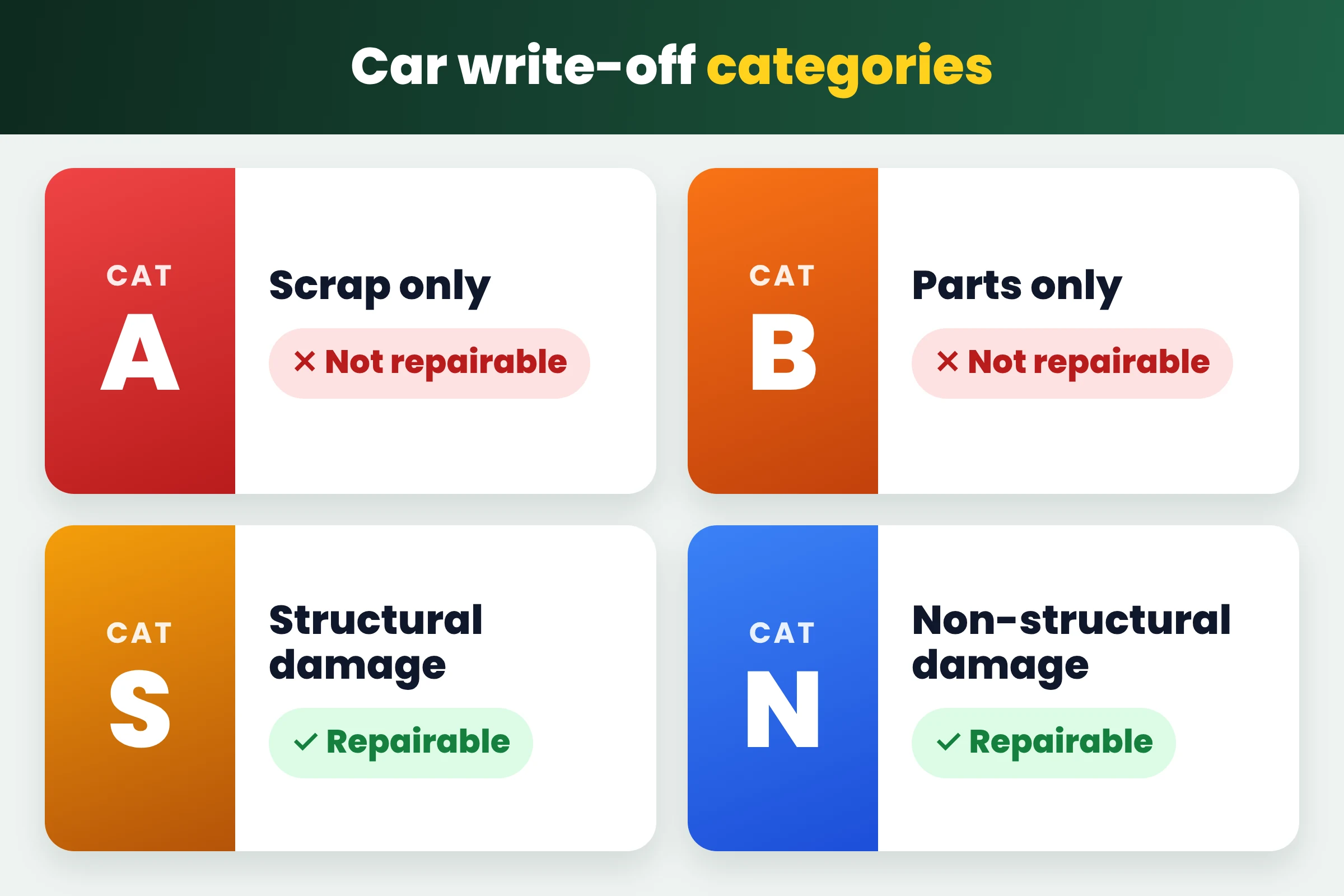
When an insurer decides a car isn't worth fixing, it calls it a total loss and gives it one of four categories under the Association of British Insurers' salvage code. Two categories mean the car can never return to the road. The other two allow it back once someone repairs it to a roadworthy standard.
| Category | Damage | Back on the road? | What happens to it |
|---|---|---|---|
| Cat A | Severe, often after a fire | Never | Goes to the crusher whole |
| Cat B | Severe damage to the body | Never | Goes for parts, then the shell goes to the crusher |
| Cat S | Structural, such as a bent chassis or crumple zone | Yes, once repaired | Usually sold at a salvage auction for repair |
| Cat N | Non-structural, such as panels, lights or electrics | Yes, once repaired | Usually sold at a salvage auction for repair |
Before October 2017, insurers used Cat C and Cat D, which went by the cost of the repair. Cat S and Cat N describe the type of damage instead. So a Cat N car can still have had a big repair bill, as long as the chassis and crumple zones came through unharmed.
How to check if a car has been written off
Each of these checks can miss something on its own, so it's worth doing all four. The first one you can do from home.
1. Pay for a history check
Insurers report every write-off to the Motor Insurance Anti-Fraud and Theft Register, known as MIAFTR. Free checks can't see it, but paid history checks from firms such as HPI do. Expect to pay around £10 to £20. A good report shows the category, the date and sometimes the area of the damage. Run it before you set off to the viewing, so you don't waste a trip.
2. Read the V5C logbook
When the owner tells the DVLA about a write-off, the DVLA adds the category to the V5C logbook. Read it carefully at the viewing. Ask about a logbook issued recently on an older car too. Owners who keep a Cat S car send the old one to their insurer and apply for a replacement on form V62.
3. Look at the MOT record
The MOT record won't name a write-off, but it can drop a hint. A long gap in its MOT history, with no test for a year or more, often means the car spent months off the road while someone repaired it.
4. Ask the seller directly
Ask whether the car has ever been a write-off, and listen to how they answer. Under the Consumer Rights Act 2015, a dealer must describe the car accurately, and a private seller can't lie about it either. A vague or awkward reply is a good reason to look harder at the car and the paperwork.
GOV.UK explains how the categories work and what owners must do in its page on insurance write-offs.
Signs of a repaired write-off
A history report can confirm a write-off, but only a close look at the car shows how good the repair was. Here's what to look for on the driveway:
- Paint that's a slightly different shade on one panel, or overspray on rubber seals and trim
- Gaps between the panels that are wider on one side than the other
- Fresh welds, sealant or underseal in the boot floor or around the engine bay
- The steering wheel sitting off centre when the car drives straight
- Airbag, ABS or other warning lights that stay on
- A damp, musty smell, rust on the seat runners or silt under the carpets, which can point to flood damage
If you own a paint depth gauge, take it along. A reading that jumps on one panel shows fresh paint. One of these signs on its own doesn't prove much, but several together on a car with a clean history report suggest the owner repaired accident damage privately, without an insurance claim.
Should you buy a Cat S or Cat N car?
It comes down to three things: the price, the quality of the repair and how long you'll keep the car. We've seen Cat N cars run for years without a problem after a good repair, and Cat S cars that pulled to one side for the rest of their lives after a cheap one.
When it can make sense
- The price is well below a clean car of the same age and mileage
- The seller has photos of the damage and invoices for the repairs
- An independent inspection, such as one from the AA or RAC, finds nothing worrying
- You plan to keep it for a long time, so the lower resale value matters less
When to walk away
- The seller didn't mention it until you asked, or at all
- There's no proof of who repaired it or how
- Your insurer won't cover it, or quotes far more than for a clean car
- It's Cat S and the price is only slightly lower
There's one big difference between Cat S vs Cat N cars to keep in mind. No law says anyone has to inspect a repaired Cat S car before it goes back on the road. An MOT only covers the parts on the MOT checklist, on the day of the test. It doesn't check the quality of the structural repair.
Is my car a write-off? When it's your own car
If your insurer decides your car is a total loss, it offers you what the car was worth just before the accident. You don't have to take the first figure. Find adverts for the same model, age and mileage on sites like Auto Trader, and send them to the insurer if the offer looks low.
You can often buy a Cat S or Cat N car back from the insurer for its salvage value and repair it yourself. Either way, you must tell the DVLA the car is a write-off, or face a fine of up to £1,000. If you keep a Cat S car, send the whole logbook to your insurer and apply for a replacement on form V62.
Frequently asked questions
Does a Cat N car show on the V5C logbook?
It should. Once the owner tells the DVLA, it records the category on the V5C. Older write-offs, or ones nobody reported, can slip through, so pay for a history check as well as reading the logbook.
Is it hard to insure a Cat S car?
It can be. Some insurers won't cover Cat S cars at all, and others charge more. Cat N cars are usually easier. Get an insurance quote before you agree a price.
Can you get finance on a Cat S or Cat N car?
Sometimes. Plenty of lenders refuse written-off cars, as the car is worth less if they need to take it back. Ask the lender before you agree a price with the seller.
What do Cat C and Cat D mean?
They're the old categories, used until 1 October 2017. Cat C meant repairs cost more than the car was worth, and Cat D meant repairs cost less. You'll still see them on older cars and in some history reports.
Do I have to tell a buyer my car is a write-off?
A dealer must tell you. A private seller can't lie about it if you ask, and it shows up on any paid check anyway. Telling buyers upfront saves everyone time, as they'll find out anyway.